128K of Context, 1.6 GB of KV Cache
LFM3-1.7B keeps a 128K context in 1.6 GB of KV cache, 37% of Qwen3.5-4B: only 6 of 24 layers are global attention. It averages 49.37 against a 9B model, but wins on behavior, not agentic coding.
Numbers come from Liquid AI's launch post (Oct 27, 2026) and the model cards. Percentages, ratios and gaps are our arithmetic on the published numbers. We did not rerun either model, and the comparison set is the one Liquid AI picked. One section is ours: how that average is built. Anyone can check it against the same table.
Weights:
LiquidAI/LFM3-*on Hugging Face.
An agent holding 128K of context. A whole repository, a whole manual, a full day of tool output.
It runs on a phone, on a Raspberry Pi 5, on a laptop without a discrete GPU. The KV cache bill for that context is 1.6 GB, weights not included.
Three things worth separating: where that 1.6 GB comes from, how the report card becomes an average, and what the model is actually for.
That is LFM3-1.7B. The same model scores 49.37 across the 29 rows Liquid AI published, against 47.24 for Qwen3.5-9B.
A 1.7B model beating a 9B one sounds like an architecture revolution. Split the claim in two and the picture gets much clearer.
Six of its 24 layers are still global attention. And that average is 29 equal-weight rows. Taken apart, the biggest wins sit on one axis and the biggest losses are about knowledge or distance.
What 128K actually costs
Start with something nobody disputes.
Every time a model emits a token, every attention layer looks back over all the tokens before it. Recomputing that is too expensive, so the intermediate results get stored. That store is the KV cache.
It scales with the number of layers that keep KV, the context length, the number of KV heads, and the head dimension. Every layer, every KV head, every token keeps a K and a V vector.
So "supports 128K" is one line on a product page and a few gigabytes in memory.
Liquid AI's own comparison is blunt: at a full 128K, Qwen3.5-4B needs 4.3 GB of KV cache and MiniCPM5-2B needs 5.6 GB.
This hurts agents specifically. One tool output is thousands of tokens, context only grows across turns, and you want the thing sitting in the background all day.
I think the real cost of long context is not the prefill pass. It is that you have to keep holding that memory. A phone does not have the budget, so the agent stays short.
Its answer: 24 layers, only 6 of them full attention
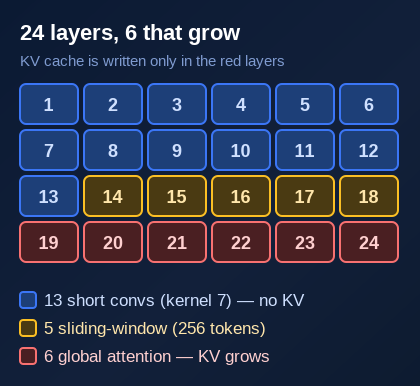
The 24 layers of LFM3-1.7B are not the same kind of layer.
| Operator | Layers | Sees | Stores KV? | Job |
|---|---|---|---|---|
| Gated short convolution (kernel 7) | 13 | 7 tokens | No | Local patterns: syntax, word order |
| Sliding-window attention (window 256) | 5 | The last 256 | Only 256 tokens | Paragraph-level links |
| Global attention | 6 | The whole context | Yes, growing with context | The rare case where a sentence 10,000 tokens back is the key |
Table 1: how the 24 layers are built (Liquid AI launch post)
A convolution has no key/value table, only a fixed-size filter. So those 13 layers write no KV cache at all.
Sliding-window attention does keep KV, but only for the last 256 tokens. It does not grow.
Only those 6 global layers inflate.
As Figure 1 shows, spread the 24 layers out and only the red ones get fatter as the conversation grows.
Now the part that gets lost: this is not a Transformer replacement.
Six of 24 layers are still global attention, a quarter of the stack. The other 13 convolutions plus 5 sliding-window layers just encode the fact that most of the time you do not need full attention. Jamba and Griffin walked the same road. Hybrids are not new.
Some launch coverage called it a non-Transformer architecture that beat Transformers. Count the layers and you find diluted attention rather than removed.
One small detail is worth a look. Every attention head's output passes through a sigmoid gate, so a head with nothing to add can switch off. Liquid AI says this can help suppress activation outliers, which is exactly what quantization hates.
What you get: 128K in 1.6 GB
| Model | Params | KV cache at a full 128K | vs LFM3 |
|---|---|---|---|
| LFM3-1.7B | 1.7B | 1.6 GB | 1× |
| Qwen3.5-4B | 4.7B | 4.3 GB | 2.7× |
| MiniCPM5-2B | 2.5B | 5.6 GB | 3.5× |
Table 2: KV cache at 128K context (official numbers, same measurement)
In relative terms, 1.6 GB is 37% of Qwen3.5-4B and 29% of MiniCPM5-2B.
That is not a small saving. KV cache scales with context, so one measured point at 128K tells you every other length — approximately: the five sliding-window layers keep a fixed 256-token block, which matters more when the context is short. What it saves is not compression. It is that far less needs storing in the first place.
That shows up on devices. Across phones, a Raspberry Pi 5 and laptops, LFM3-1.7B decodes fastest of the comparison set, 1.8 to 2.8 times faster, with the smallest memory footprint.
Conditions matter: that is llama.cpp, Q4_0, 32K context. Do not mix it with the 128K KV numbers.
Scale matters too. This is not only a text model. One LFM3-1.7B-Base backbone branches into six models around 2B: text, vision, audio, omni, and two decision models that only answer questions. It is the same idea as one trunk, four modalities, at 2B scale.
Pretraining used 22T tokens, with a 128K vocabulary carried over from LFM2.5-8B-A1B, which Liquid AI says tokenizes non-Latin scripts more efficiently. The final 3.5T tokens were mid-training that pushed the window to 256K.
Note the two numbers: the model supports 256K, but 1.6 GB is the 128K KV cache.
That average is 29 equally weighted rows
The official table has 29 rows. Average: 49.37 against 47.24.
On its face there is nothing to dispute. But I wanted to know how that average was computed, so I averaged the 29 rows myself.
I got 49.37 and 47.24, exactly as printed.
So it is an equal-weight average: IFBench counts 1/29 and so does SWE-bench, whether or not the task matters to you.
The 29 rows are not 29 distinct tests either: Claw-Eval appears twice, Humanity's Last Exam twice, AA-Omniscience three times. Deduplicated it is 25. That number comes back below.
That is where it gets interesting. Sorted by gap, the widest twelve look like this:
| Benchmark | LFM3-1.7B | Qwen3.5-9B | Gap |
|---|---|---|---|
| AutomationBench | 41.29 | 15.10 | +26.19 |
| IFBench | 73.03 | 48.84 | +24.19 |
| LiveClaw | 45.60 | 35.77 | +9.83 |
| WebArena-Verified | 38.42 | 28.94 | +9.48 |
| BFCL V4 (tool calling) | 71.39 | 62.83 | +8.56 |
| IFEval | 96.66 | 92.08 | +4.58 |
| RULER 128K | 65.56 | 87.11 | −21.55 |
| GPQA Diamond | 63.37 | 80.40 | −17.03 |
| SWE-bench Multilingual | 23.00 | 35.00 | −12.00 |
| MCP-Atlas | 32.57 | 42.67 | −10.10 |
| Humanity's Last Exam | 7.17 | 16.41 | −9.24 |
| SWE-bench Verified | 43.40 | 51.20 | −7.80 |
Table 3: twelve wide gaps out of the 29 rows (six wins, six losses). This is my pick, not the top twelve by size — see the note below.
The top six are "follow the format", "call the tool correctly", "click through the page". The bottom six are "how much do you know", "how long do you remember", "can you actually change the code".
This table is my pick, not the whole story. The two widest gaps are not on it: AA-Omniscience non-hallucination at +40.3 (92.93 against 52.59) and its raw score at +28.5. Both sit in the knowledge block.
Neither measures stored knowledge. They measure calibration. "Say you do not know when you do not know" is behavior shaped by post-training; answering GPQA is not. That row is a big win, and what it measures is discipline, not erudition.
Slice it a few other ways and it gets clearer still:
| Slice | Rows | LFM3-1.7B | Qwen3.5-9B |
|---|---|---|---|
| Official average | 29 | 49.37 | 47.24 |
| Behavior (agents 7 + tools 4 + instruction 4) | 15 | 61.03 | 55.25 |
| Everything else, 14 rows (coding 6 + knowledge 6 + long context 2) | 14 | 36.88 | 38.66 |
| of which agentic coding | 3 | 26.44 | 34.73 |
| of which long context | 2 | 59.20 | 74.56 |
| Without the three AA-Omniscience rows | 26 | 51.20 | 51.24 |
Table 4: the same report card, several ways (row one is the printed official average; the rest is my arithmetic on the official numbers)
Behavior is 15 rows, more than half the weight. LFM3 wins 11 of them.
The last row is the one I would look at. AA-Omniscience appears three times in that table: raw score (0.50 against −28.00), accuracy (7.07 against 13.17) and non-hallucination rate (92.93 against 52.59). One exam, three facets, three votes.
Together those three rows contribute +62.7 points of gap; the whole margin is +61.7. Drop all three and the remaining 26 rows come out 51.20 to 51.24, the gap going from +2.13 to −0.04.
Drop only one of them and the story flips back: the lead stays somewhere between +0.8 and +2.4. So "three rows carry the entire margin" is only true when all three leave together, and that should be said out loud.
The sharper objection is not triple counting but sign. −28.00 is an index that can go negative, not a percentage. Averaged with percentages, that single row moves Qwen's mean by nearly a full point on its own.
I am not saying the math is wrong. That is what an equal-weight average does: swap one benchmark in or out and the conclusion moves. And whether those three rows were chosen by Liquid AI or reported that way by the benchmark house, I cannot tell from the table.
The point is smaller and more useful: an average is a design decision, not a conclusion.
And it is not a clean sweep. Tool calling looks like the strength, yet MCP-Atlas loses by 10.1. Agentic coding loses all three rows, SWE-bench Multilingual by 12.
Liquid AI says it plainly themselves: "Larger models still win on agentic coding and knowledge, where size matters most."
Behavior can be taught. Knowledge cannot.
Why does the report card look like that? The training explains it.
| Stage | Scale | What it does |
|---|---|---|
| Pretraining | 22T tokens | General knowledge; the final 3.5T is mid-training that extends context to 256K |
| SFT | 1.75T tokens | Chat, reasoning, tool calls, agent traces |
| Mixed RL | Many domains at once | Math, code, SQL, structured output, with a length penalty in the reward |
| MOPD distillation | 6 specialist teachers | Code, math, tool use, long context, agentic work, enterprise workflows, distilled back into one model |
| Agentic RL | Real harnesses | Web browsing through office work, run inside real agent environments |
Table 5: the post-training stages Liquid AI published (first row is pretraining)
"Answer in IFBench's format" is behavior. Behavior can be demonstrated, rewarded, distilled from a teacher. That is what 1.75T tokens of SFT buys.
"Answer GPQA correctly" needs knowledge. The way I read it, knowledge comes from pretraining, and knowledge density is tied to parameter count. 22T tokens is a lot; it still cannot fill a 1.7B model.
The report card is coherent. It overtakes on the behavior axis and stops where a 2B model stops on the knowledge axis.
Long context is the same knot in another place. What it saves is memory, not comprehension. RULER 128K is 65.56 against 87.11. Fitting something into the window and using it are two different things.
Liquid AI offers an interesting direction: with search, Humanity's Last Exam goes from 7.17 to 13.90, nearly double. The gap to Qwen3.5-9B narrows from −9.2 to −3.6.
Narrower, not closed. Tools cover part of a knowledge gap; they do not cover all of it.
For anyone choosing a model, this raises a practical question: is your task a behavior task or a knowledge task?
Fill a fixed form, order the tool calls correctly, click through five steps: behavior. A 1.7B model is worth trying.
Answer what the third parameter of an API defaults to, read 50 pages of contract and find the contradiction: knowledge. A 2B model will answer smoothly and be wrong, and you will find out one afternoon too late.
"Liquid" is a 2020 story
The name comes from Liquid Neural Networks. It has a real origin, and it has come loose from the architecture.
In June 2020, a paper called Liquid Time-constant Networks appeared; AAAI published it in 2021. The authors are Ramin Hasani, Mathias Lechner, Alexander Amini, Daniela Rus and Radu Grosu — five of them. In 2023 several of that group spun out of MIT CSAIL to found Liquid AI. The name is lineage, not marketing.
Now look at how Liquid AI describes the architecture. LFM2, they write, showed that a hybrid of short convolutions and attention could run fast on-device, and that design came from automated hardware-in-the-loop architecture search.
LFM3 just widened the search. LFM2 searched over one phone and one laptop; LFM3 searches over 14 device and backend combinations, from a Galaxy S26 Ultra and a OnePlus 15 through a Raspberry Pi 5, Apple M4 Max, AMD Ryzen AI, Arm and x86 cloud CPUs, GPUs, and the Qualcomm Hexagon NPU.
The accurate sentence is: the name comes from history, the architecture comes from search.
This is not bait and switch. Companies keep their research lineage in the name all the time. But if you clicked because of "liquid neural network", know that the mechanism is not in there.
So who is it for
Three kinds of people, three answers.
If you run an agent on a device, this is one of the most interesting options at this size. A 128K context in 1.6 GB, BFCL 71.39 for tool calling, 1.8 to 2.8 times faster decoding, and six models sharing one backbone so you load only the modality you need.
If you have one narrow task, this may be the most practical idea in the post. Liquid AI's demo used the vision model — LFM3-VL-2B, not the text model above — finding and classifying defects in drone photos of wind turbine blades:
- About 3,000 public photos (WTBs2025), SFT plus GRPO, a few hours on one A100
- Measured on about 1,400 held-out photos: 67% classification accuracy, detection F1 from 0.003 to 0.11
- Against a zero-shot GPT-6 Luna at 0.01
With one number that is easy to skip: out of the box, both models identified fewer than 10% of those images.
So 0.003 to 0.11 is "from nearly unusable to marginally usable", not "from good to better". And it is Liquid AI's own experiment, not an independent replication.
If you want a general knowledge assistant, it is not the tool. HLE 7.17, GPQA 63.37, RULER 65.56. Those are the ceiling.
A few things to keep in mind:
- The comparison set is Liquid AI's own pick. No third-party replication, no independent rerun
- The average is equal-weight. The benchmark you care about may be 1/29 of it
- It saves memory, not long-context ability. RULER 65.56 against 87.11
- Open weights are not a free license. It is the LFM Open License v1.0; read it before commercial use
- All six models branch from one base. Switching modality is switching weights, not architectures
Three things you can do tomorrow
- Next time you see a benchmark average, count the rows. The official table has 29, and the average is equal-weight. Recomputing it takes five minutes and tells you which rows carry it. That is worth more than reading ten reviews.
- Compute your own KV bill. Multiply six things: tokens × layers that keep KV × KV heads × head dimension × 2 (K and V) × bytes per element. All six are in the model config. If you only need 8K of context, 1.6 GB is not your number; scaled down it is about 100 MB.
- If your task is narrow, fine-tune a 2B model once. One A100, a few hours, a few thousand photos. That is the scale that is available now. It will not be general, but it might be enough.
If what you actually want is a large model on your own machine, we have written about the other lever: quantizing a 122B model one layer at a time. There you shrink the model instead of the window.
Scale did not disappear. It moved, from the GPU you can buy to the task you can shape.