Physics-informed AI for complex urban systems
How do you put physics into city-scale models? This survey proposes a taxonomy of three paradigms and seven methods, reviews eight urban subsystems, and names what is still missing.
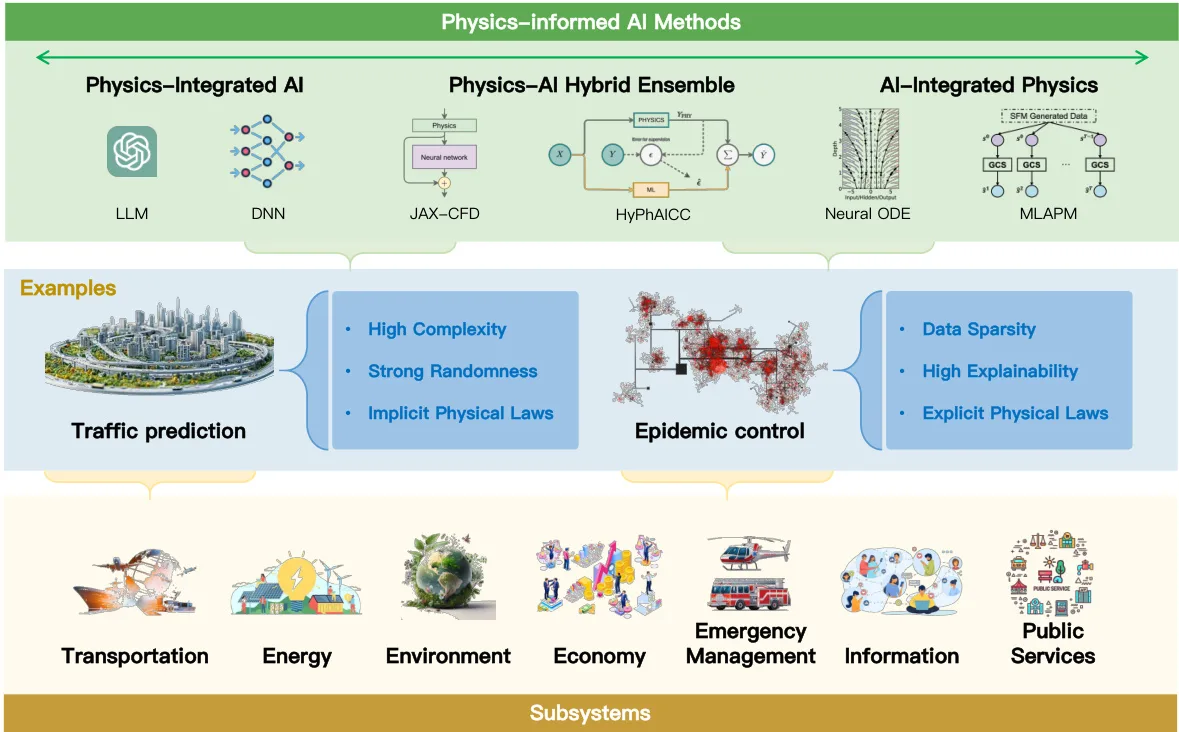
Paper — arXiv:2506.13777Title — A Survey of Physics-Informed AI for Complex Urban Systems
Why this survey exists
Cities are the awkward middle ground of modelling. Pure physics cannot capture human behaviour; pure data-driven models cannot explain themselves, and they break exactly when conditions change — which is when a city most needs a prediction.
Physics-informed AI (PIAI) is the attempt to have both. Its selling point is a model that respects conservation laws and heat transfer while still learning from data.
The survey's contribution is organisational: a taxonomy of three paradigms and seven methods, a review of applications across eight urban subsystems, and an honest list of what is still missing.
The taxonomy
| Paradigm | Method | Core idea | Typical techniques |
|---|---|---|---|
| Physics-integrated AI | 1. PINN with loss function | physics constraints as a loss term | PINN, CPINN, PCNN |
| 2. PINN with weight initialisation | initialise weights from physical knowledge | transfer learning, self-supervised pretraining | |
| 3. PINN with architecture design | bake physical structure into the network | symmetry encoding, Hamiltonian structure | |
| Hybrid | 4. Sequential ensemble | physics and AI cooperate in stages | residual modelling, pipeline architectures |
| 5. Parallel ensemble | run both, fuse the outputs | dynamic weighting, model combination | |
| AI-integrated physics | 6. AI-discovered physics | let AI find the governing law | SINDy, symbolic regression |
| 7. Neural physics model | replace the hard-to-model part with a network | neural closures for turbulence |
The useful distinction is where physics enters: as a penalty, as an initialisation, as architecture, as a co-model, or not at all (physics emerges from data).
Where it is used
| Subsystem | Physical law / model | Example application |
|---|---|---|
| Energy | power flow equations, pressure balance | grid optimisation, renewable integration |
| Environment | Gaussian plume, SWMM hydrology | air quality, flood simulation |
| Economy | network flow, Huff choice model | supply chain, demand forecasting |
| Transport | LWR traffic flow, car-following | state estimation, signal control |
| Information | Shannon capacity, ray tracing | information diffusion in social networks |
| Public services | SIR epidemic, social force | outbreak forecasting, crowd evacuation |
| Emergency | social force, spatio-temporal decay | disaster dynamics, post-disaster mobility |
Highlights from the review: PINNs reconstructing wind farms and predicting solar output; Kirchhoff-constrained networks accelerating optimal power flow; diffusion–advection equations fused with neural networks for pollutant forecasting; LWR/ARZ models combined with deep learning to estimate traffic state from sparse sensors; neural ODEs modelling opinion dynamics; epidemiological neural networks fusing multi-source data for outbreak prediction.
The last section is the most interesting: cross-domain coupling — graph neural networks linking flood dynamics with transport models to simulate a city under extreme weather — and multi-scale integration, from building-level thermal models up to regional climate.
The open problems
The survey is refreshingly blunt about what is unsolved:
- Weak theory — convergence and generalisation of PINNs lack rigorous proofs
- Compute — training cost is high, which rules out real-time deployment
- Knowledge representation — causal and rule-based (non-numeric) knowledge is not integrated
Proposed directions include multi-resolution architectures, active and transfer learning, combining PIAI with LLMs, and building urban digital twins or general world models.
What I take from it
Two observations in the paper are worth more than the taxonomy itself:
Cities are the natural testbed for PIAI precisely because they combine physical regularity with human unpredictability. Both extremes exist in the same system, so a method that only works for one of them will fail visibly.
Data-rich tasks drift toward AI-led methods; decision-support tasks need physical interpretability. That is a practical rule for choosing a method — not based on what is fashionable, but on who has to defend the output.
For anyone building city-scale models, the "how do I choose" section is the one to read first: physical knowledge availability, data density, and whether the deliverable is a number or a decision.