Discovering governing equations from scarce data with PiDL
PiDL recovers the PDEs behind nonlinear spatio-temporal systems from sparse, noisy observations. Notes on its architecture, training strategy, and results on Burgers and Navier–Stokes.
Paper — arXiv:2005.03448Title — Physics-informed learning of governing equations from scarce data Authors — Zhao Chen¹, Yang Liu², Hao Sun¹˒³ ¹ Northeastern University, Civil & Environmental Engineering ² Northeastern University, Mechanical & Industrial Engineering ³ MIT, Civil & Environmental Engineering
Abstract, in short
Recovering the governing equations of a complex physical system from data is what turns observations into a model. This paper proposes PiDL, a physics-informed deep learning architecture that discovers the governing PDEs of nonlinear spatio-temporal systems from scarce and noisy data.
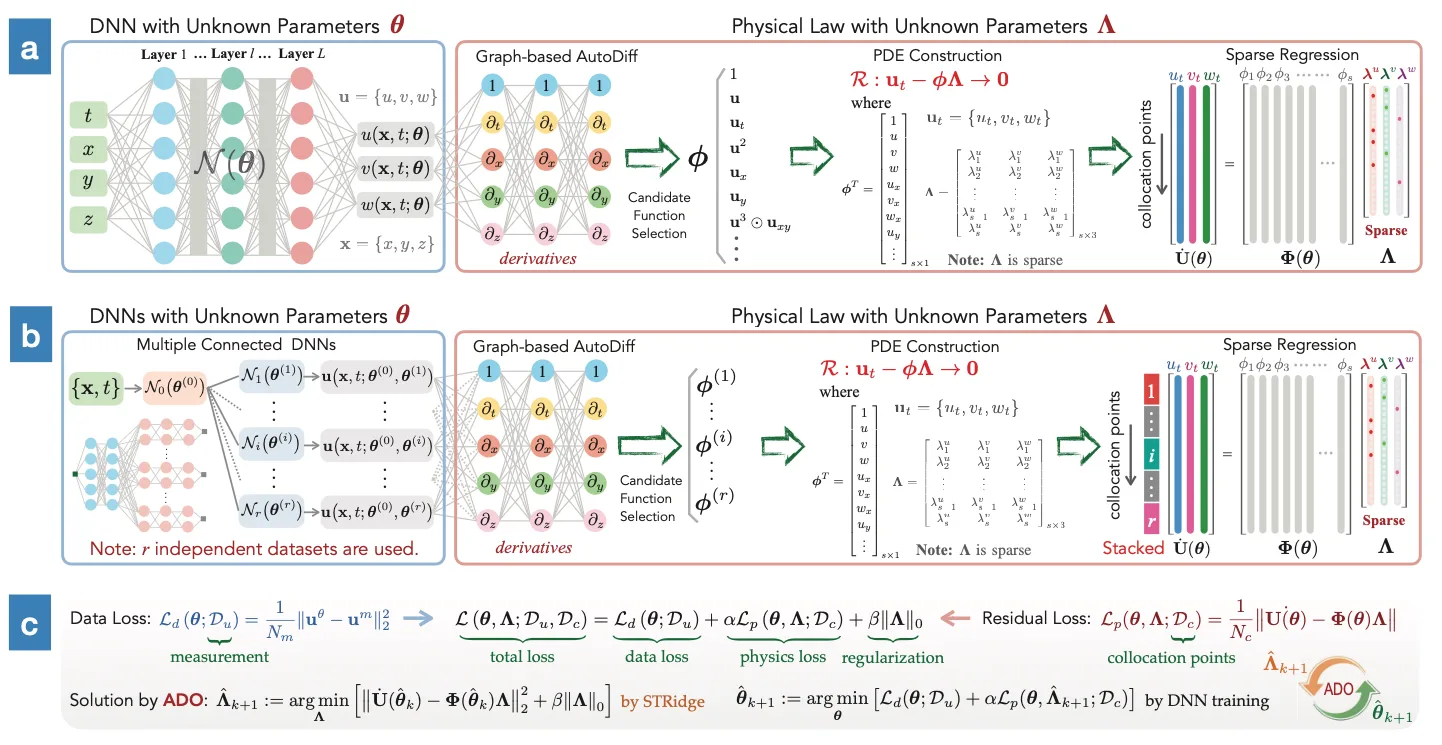
It fuses four things: the representation power of deep neural networks, physical embedding, automatic differentiation, and sparse regression. Three goals:
- Approximate the solution of the system state
- Compute the relevant derivative terms
- Identify which terms and coefficients actually form the PDE
Keywords — governing equation discovery, physics-informed deep learning, PDEs
Why the problem is hard
Classical PDE modelling relies on first principles — conservation laws and the like. But for many complex systems, the analytical form is simply unknown.
Data-driven methods such as SINDy are limited by data quality and quantity, and numerical differentiation is notoriously sensitive to noise. Ask for derivatives from noisy, sparse measurements and the noise gets amplified into the coefficients you are trying to identify.
The PiDL framework
The loss combines data fit, physics residual, and sparsity:
How the pieces fit together
- A DNN learns the representation of the solution
- Automatic differentiation computes derivatives accurately
- ℓ₀ sparse regression picks out the governing terms
Architecture
- Single dataset: the DNN directly models the solution function
- Multiple datasets: a "root-branch" DNN handles different initial/boundary conditions
- a shared root network captures common features
- independent branch networks adapt to each condition
Optimisation (ADO) — alternating direction optimisation trains the network parameters and the PDE coefficients in turn, which sidesteps the NP-hard ℓ₀ problem.
Results
| PDE | Noise | Coefficient error | Data used |
|---|---|---|---|
| Burgers | 10% | 1.15% | 1.95% |
| Kuramoto–Sivashinsky (chaotic) | 10% | 0.71% | 12.3% |
| Navier–Stokes | 10% | 1.40% | 0.22% |
| Schrödinger | 10% | 2.31% | 37.5% |
Multiple-dataset settings were tested on Burgers with small-viscosity shock waves and on the FitzHugh–Nagumo neuron model.
The real-world test is the interesting one: on a cell migration and proliferation experiment, the method recovered the Fisher–Kolmogorov model,
Why it matters
It breaks the data wall. Accurate discovery under 10% noise with less than 1% of the original grid is the headline result.
It stays interpretable. The DNN provides a global approximation, while the sparse PDE constrains the network.
It generalises to expensive domains — fluid mechanics, biological migration, climate prediction — where you can never collect a dense dataset.
My take
The valuable idea here is not "use a neural network". It is the separation of concerns: let the network own the function, let sparse regression own the equation, and let AD bridge the two. Each part is something you can reason about and check.
The weakness is the same one every physics-informed method shares: the library of candidate terms is a human decision. If the true governing term is not in the candidate set, no amount of optimisation will find it.